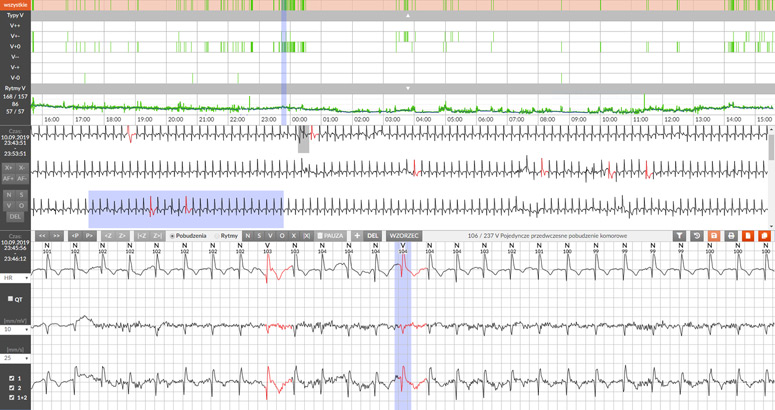

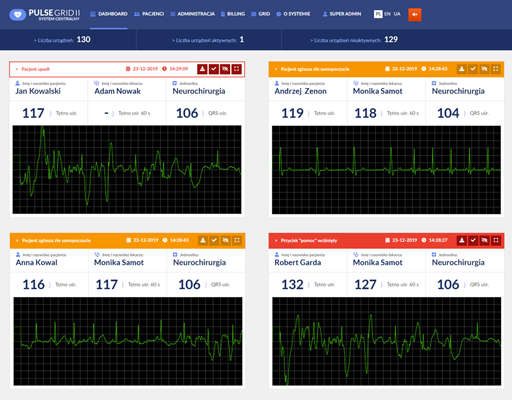
Exemed is a company manufacturing advanced technical solutions for medicine. It helps medics take care of a patient by allowing them to constantly monitor the patient’s ECG. The telemedical PulseGrid II system offers permanent, real-time remote monitoring of patients’ ECGs from everywhere. It is applied in hospitals for day-to-day care. The Holter monitor mode helps doctors manage and analyze the cardiac data collected long-term outside of the hospital conditions.
The Client approached us with a project needing developers to build the entire front-end layer of the web application providing the data collected by ECG monitoring devices. The primary objective was to make an app that works smoothly, presents vast amounts of data in a user-friendly way, and functions as an official medical product.
“The quality of their work is excellent. Their development support was a critical factor in successfully launching our business. They invested thoughtful consideration into the build phase and carefully tailored every aspect of the product.”

The end-users of the application are doctors and nurses who diagnose and monitor patients based on provided data. It has to be displayed in the most intuitive way reducing the risk of wrong interpretation of the results. The developers we provided had to design the UI for two separate modules. One of them is used to monitor ECGs of up to 9 patients in real-time at hospital wards. Cardiologists use the other to analyze in detail the patient’s cardiac data collected by a Holter monitor device.
The client had a central system that collects and analyzes data from portable devices. Our developers’ job was to define the API needed to fetch the data and build the web application. The web application had to smoothly handle vast amounts of data both in real-time and batch modes. It had to match the performance of the existing desktop solutions that use local memory to store and provide the data.
We started by conducting a workshop with cardiologists and nurses to understand the needs of the end-users. We also analyzed the existing desktop solutions to see how the expected functionality works. Following the user-centered design, our team worked iteratively on the user interface starting with simple sketches of the screens. After each step, we collected feedback from the users, which we used to build the next iteration of the UI project. Finally, we were able to build clickable wireframes that met users’ requirements. We used that to build a highly usable user interface.
At first, we defined the API of the web application and the optimized data format for medical signals transfer. We then moved to design communication architecture between the backend and the frontend of the application. We chose web sockets for communication to ensure fast transfer, data integrity, and signal continuity. During the design process, we had to dive deep into the performance constraints of the supported browsers. All those measures ensured that the presented ECG signal was refreshed in real time without data loss.
The app went through a 6-months testing period performed together with a certification organization. It is compliant with standards for medical devices which is confirmed by the issued certificates. The app is now used by several medical centers in Poland. We are still involved in app development and maintenance.